


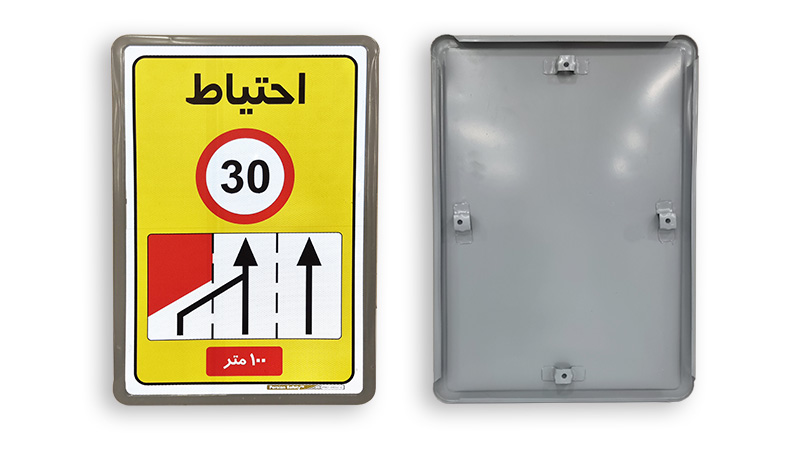
Framed Traffic Signs
These signs are used on highways, streets, local roads and in parking areas—wherever motorists need to receive instructions or warnings. They are intended specifically to communicate with drivers and should not be used for unrelated purposes.
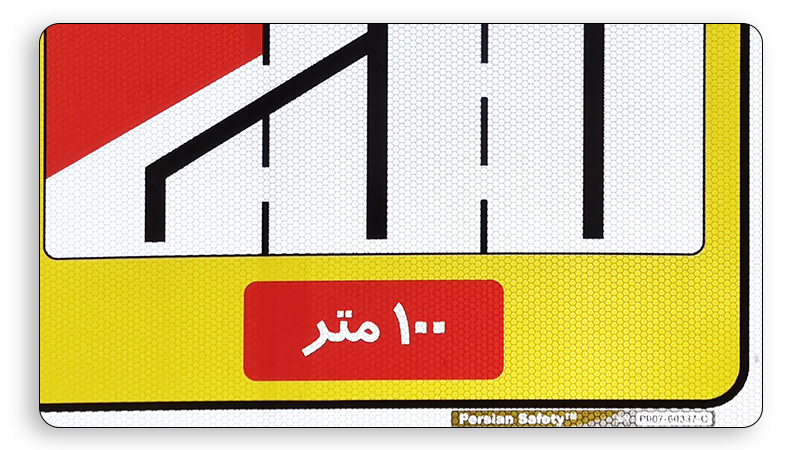
Road traffic signs must remain visible in vehicle headlights. For this reason, retroreflective sheeting is used: it reflects light from approaching headlights so that signs can be seen at night.
Material and Shapes of the Pressed Metal Frame
The pressed-edge frame is made from steel sheet with an electrostatic protective coating. The Persian page specifies a nominal sheet thickness of 1.25 mm and describes good resistance to corrosion.
The frames are produced in standard sizes and in rectangular, square, circular, triangular and octagonal shapes.
Mounting the Framed Signs
The back of each sign is prepared for the fittings needed to attach it to a mounting pole.
When placing an order, you can add the required clamps and the pole itself. If you already have mounting hardware, you can order the sign without those accessories.
Mounting Poles for Retroreflective Signs
Sign-mounting poles are finished with an oven-cured electrostatic coating. Two installation options are available: in-ground poles, with an opening near the bottom to accommodate a reinforcing bar, and flanged poles designed for surface mounting.
The top of the mounting pole is closed to help prevent rain and dirt from entering. The electrostatic coating offers better durability than ordinary liquid paint and is available in a range of colours.
Retroreflective Sheeting Options
Two grades of retroreflective sheeting are offered: a seven-year honeycomb-type grade and a three-year standard grade. Both are presented as quality materials, but the seven-year grade offers greater durability and stronger light reflection.
For signs viewed at short distances, such as inside a car park, the three-year grade may be suitable. For outdoor roads and locations with faster-moving traffic or longer viewing distances, the seven-year grade is the recommended option.
Direct UV Printing on Retroreflective Sheeting
In the past, road signs were produced by cutting separate pieces of reflective film and applying them to the sign face. With the introduction of flatbed UV-printing technology, graphics can instead be printed directly onto the reflective sheeting.
With flatbed UV printing, the design is printed directly onto the reflective surface instead of being assembled from separately cut, coloured pieces. The Persian source also refers to established manufacturers such as 3M adopting this technology. Only the outer outline of the reflective sheet needs to be cut. The process improves consistency from sign to sign and helps avoid loose sections of applied reflective film, lifted edges and trapped air.
Watch the Product Introduction Video
To learn more about this product, watch the short introductory video provided on this page.


